
“Be patient toward all that is unsolved in your heart
and try to love the questions themselves,
like locked rooms and like books
that are written in a very foreign tongue.”
Rainer Maria Rilke, Letters to a Young Poet, 1903.
I remember myself between the ages of five and eight. Each summer, my parents sent me to spend the season with my grandparents in Yerevan, the capital of Armenia. It was the city where I was born, though we had moved away when I was four. I loved these temporary journeys back to a place that felt like home. The weather was beautiful, the food tasted like the sun, and the streets were framed by grand buildings constructed from pink tuff, a volcanic stone that seemed to absorb and return light, changing tone throughout the day. In the mornings it appeared pale and dusty, by afternoon warm and saturated, and by evening almost rose coloured. I was certain this stone existed only in Yerevan. During those summers, my almost daily routine was to accompany my grandmother, Evelina Artemievna Piradova, to her work as a tour guide at the Manuscript Museum and Research Institute of Matenadaran, where I would spend the day until three or four in the afternoon.
The centre of the city is relatively small, so each morning we made our way on foot along Mashtots Avenue. The city’s largest boulevard, it was constructed in the style of spacious Parisian thoroughfares and opened onto a breathtaking view of the monumental, cube like edifice of the Museum of the Matenadaran (Fig. 1). Built of local grey basalt, it rose approximately twenty-two metres above street level at the end of the avenue. No buildings could be seen behind it or beside it, and it appeared as though the city itself culminated in the fortress-like presence of Matenadaran. It felt at once like a guard and a gateway. At that time, I believed there was nothing more monumental in the world than this place where my grandmother worked and where old books were kept, studied, and protected.
Entering the Institute was a slow and deliberate experience, one that a building of such magnitude appeared to require. It was not approachable and did not invite the visitor inside. Instead, it asserted itself, triumphing over anyone who drew near, demanding a pause, even a catching of breath, in the face of its strength and permanence. A monumental stairway first rose from street level to the statue of Mesrop Mashtots, the inventor of the Armenian alphabet, positioned as a symbolic threshold to knowledge. With a student at his feet, he extends his basalt hand towards the entrance. The façade, executed in the geometric restraint of medieval Armenian architecture, is guarded by sculptures of prominent Armenian cultural figures, including Toros Roslin, Anania Shirakatsi, Movses Khorenatsi, Mkhitar Gosh, and Frik, who together embody the nation’s scholarly lineage. Finally, the apparently indestructible grand copper doors echoed those of Armenian churches.
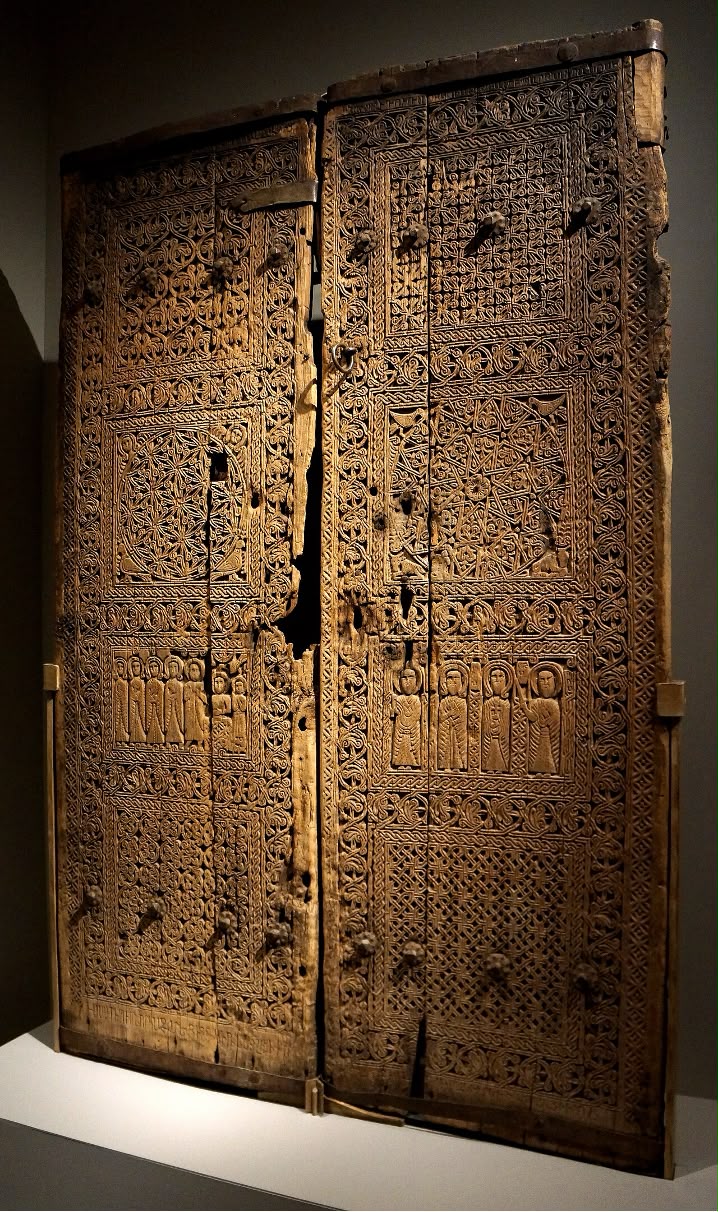
The ritual of entrance was not complete until one passed through a relatively narrow vestibule and rose into a high central hall. Like the progression of medieval monasteries, from outer space to inner sanctum, the main hall did not reveal itself immediately. After the long ascent, we would pause before the ornate walnut carved doors leading into the exhibition hall. These doors were executed as a copy of the wooden doors of St Karapet Monastery in Mush, burned, looted and destroyed in 1915 during the Armenian genocide (Fig. 2). They were carved with interlacing knotwork, symbolising divine order, and with figures of the apostles, forming a human threshold, a community, the Church as a living body. At the time, I did not know the meaning of this symbolism. To me, it was a door to the Cave of Wonders. Something precious and extraordinary had to be kept behind doors like this.
There we waited for my other grandmother, Aida Zavenovna Charachchyan, the director of the exhibition hall, to unseal the doors, as she was the one who quite literally held the keys. Each afternoon, the doors to the hall were locked and sealed with wax until morning. When she arrived, the seals were broken, the doors opened, and I was allowed to enter the rooms where all the books were. The architecture of the room was loosely modelled on the gavit, the narthex of Armenian churches. The wooden floors were covered with Persian carpets specially commissioned for the space. The hall was lit by a single window: the large, ornate metalwork rosette that also forms the central window of the museum’s façade. As a child, I would help lift the dust covers from the wooden vitrines commissioned by Vazgen I, Catholicos of All Armenians from 1955 to 1994. Then I would run through the room, checking on my favourite manuscript, making sure everything looked exactly as it always had.
I spent countless hours among illuminated manuscripts, finely bound volumes, and ancient pages. Page by page, stand by stand, I encountered different traditions of making and inscribing. Because I could not read Armenian, my mother tongue having always been Russian for various reasons, the letters in these manuscripts did not present themselves as instructions but as visual patterns: delicate brushstrokes and tender figures, alongside the quiet luxury of gold leaf. I looked not at words, but at surfaces, structures, and forms. The space of the manuscript page became both a puzzle to decipher and a painting to admire.
My favourite stand was the one that held the largest Armenian manuscript in the world (Fig. 5). Not only because it was visually overwhelming and, at the time, seemed almost the same size as my own body, but because of the story of its preservation. During the Armenian genocide, two women saved the manuscript by smuggling it on their backs, hidden beneath their clothes, from Turkey to Armenia. Because of its weight, the manuscript had to be divided into two parts, and because of its size, it could never be displayed whole. Instead, the two halves were exchanged twice a year. For me, this book came to represent beauty, and the history of my country, but also the strength of women in Armenia and beyond. I was, of course, captivated by many other manuscripts in the hall: by illustrations of ancient plants and remedies, by calendars, by depictions of historical battles, and by heavy metal bindings adorned with precious stones (Fig-s. 3-4). Yet none of these impressions could compare to the story of this manuscript’s survival. It spoke of perseverance and the tremendous weight carried on women’s bodies, of care enacted under impossible conditions, and of knowledge sustained through generations.
After the age of eight or nine I never again spent such long stretches of time in Armenia, yet there was no summer that followed in which I did not miss the experience of those early years. In later life, this childhood enchantment with Matenadaran translated into a growing interest in contemporary artists working with books. What drew me to their work was familiarity: a sense that the book remains a place in which artists can find themselves. This thesis continues that lifelong attention, shaped by scholarship, and rooted in fondness and appreciation.
(Image: Armenian, Carved wooden doors from the Church of St John the Baptist, Mush, 1212. Carved wood. The Metropolitan Museum of Art, New York. Exhibition view, Armenia!, The Metropolitan Museum of Art, New York, 21 September 2018–13 January 2019.)